From 24/7 Monitoring to Prediction In an economy where digital services are an integral part of every organization's daily operations, availability is more than just a technical metric. It is a prerequisite for business continuity, competitiveness and trust. BlueStream already has the foundations in place: continuous monitoring of networks and infrastructure, early problem detection, incident …

Next Gen NOC
From 24/7 Monitoring to Prediction
In an economy where digital services are an integral part of every organization’s daily operations, availability is more than just a technical metric. It is a prerequisite for business continuity, competitiveness and trust. BlueStream already has the foundations in place: continuous monitoring of networks and infrastructure, early problem detection, incident management, ticketing and operations based on agreed service levels, across both on-premises and cloud environments. The company’s materials extend this picture to Microsoft Azure, incorporating metrics and logs, thresholds and baselines, alert correlation, triage and runbooks. This is today’s starting point — not the end of the journey.
The Next Gen NOC we are designing represents the natural evolution of this service. The goal is to move from “see and react” to “understand, predict and prevent”. Modern observability brings together metrics, logs and traces to show not only whether a system is running, but also why a business service is slowing down or deteriorating. At the same time, dynamic alert thresholds can learn hourly, daily and weekly behavioural patterns, identifying meaningful deviations while reducing noise from unnecessary alerts.
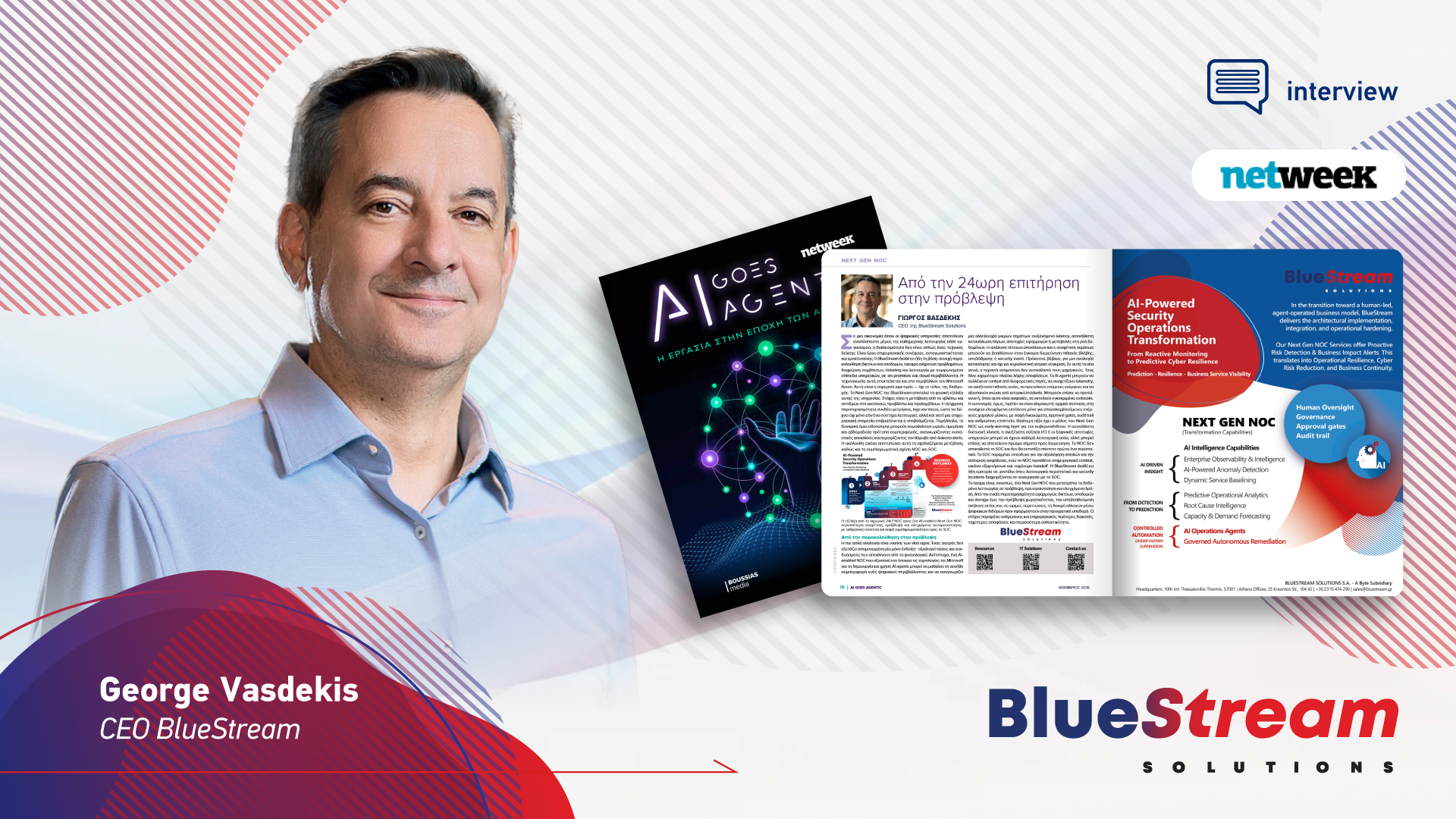
The following illustration captures this planned transition, as well as the complementary relationship between NOC and SOC.
Figure. The evolution from today’s 24/7 NOC towards an AI-enabled Next Gen NOC: greater correlation, prediction and controlled automation, with human oversight and clear complementarity with the SOC.
The simplest analogy is that of vital signs. A doctor does not examine a single indicator in isolation; they assess trends and combinations of signals that deviate from what is considered normal. Similarly, an AI-enabled NOC that makes full use of Microsoft’s technologies for building and deploying AI agents can learn the normal behaviour of a digital environment and identify a sequence of subtle signals: increasing latency, unusual resource consumption, application failures or changes in data flows. Analysing these deviations and correlating signals can help investigate potential failures, service degradation or security events at an early stage. This is, of course, an analogy intended to illustrate the concept, rather than a literal medical comparison.
In this new generation of NOC, Artificial Intelligence does not replace engineers. It provides them with a stronger decision-making framework. AI agents can gather context from different sources, correlate telemetry, investigate potential root causes, suggest next steps and leverage knowledge from historical incidents. They can also recommend or, where safe, execute approved runbooks. However, autonomy must be introduced gradually: initially through recommendations, followed by controlled execution limited to low-risk, repetitive actions, with clearly defined permissions, approval gates, audit trails and human oversight.
The role of the Next Gen NOC as an early-warning layer for cyber risk is particularly valuable. Unusual network traffic, unexplained increases in I/O or sudden service failures may have purely operational causes, but they may also represent early signals that warrant further investigation. The NOC does not replace the SOC, nor will it always be the first to detect an incident. The SOC remains responsible for threat assessment and security response, while the NOC adds operational context, visibility into dependencies and faster handoffs. BlueStream already has experience with operating models in which operational incidents and security incidents are managed in collaboration with the SOC.
The vision, therefore, is a Next Gen NOC that transforms operational data into prediction, prioritisation and controlled action. This ranges from unified observability across applications, networks, infrastructure and storage to capacity forecasting, AI-assisted root cause analysis and, in mature use cases, testing changes through digital twins before they are applied to the live infrastructure. The goal remains both human-centred and business-driven: fewer disruptions, faster decisions and greater resilience.
George Vasdekis
Chief Executive Officer, BlueStream Solutions
Source: Netweek at Vima Kyriakis